Thursday, April 25, 2013

Little White Schoolhouse

This past semester we had the opportunity to work with the community of Valley, WA to propose design ideas for the adaptive reuse of their original schoolhouse to a local museum. We began the process with an all day workshop, meeting with about twenty community members to discuss the needs and desires of the space. While there were many opinions, this made for a great learning experience. Our design needed to please many people, rather than one or two clientele. For our design our focus was to phase out the project. There were so many great ideas that would be hard to implement immediately due to time or budget. The first phase addresses a quick installation and minimal budget. The second phase focuses more on ideas that can be installed individually as the budget allows. This phase also address the need for a community gathering space. Through our design we allow the opportunity for the Little White Schoolhouse to expand and grow as the community needs change.


Tuesday, February 19, 2013

Webster Geology Museum

This collaborative project was a very new experience for me. Working with 8 other designers was both a challenge and a great learning experience. Through this I learned some very valuable skills. Collaborating with other designers is part of the everyday design world so learning how to work with 9 different design perspectives was a very positive experience. I learned how to communicate my ideas as well as how to listen and understand other's ideas as well. Because of our success collaborating, my partners and I designed a very strong space using the resources the School of Environment and Department of Physics already had available. 

Through the process there were multiple challenges including unknown specifics as to regulations and wants and needs of the School. Our group adapted well to these changes. While designing we used trial and error to find the best methods to design. At various points in the process the entire group worked together, worked individually, and worked in smaller groups to complete the project. We found that breaking into smaller groups of 1-3 people, then meeting as a whole group as the work was completed helped get the work done more efficiently. The extensive use of communication helped make sure everyone's voices and opinions were heard. 

I found throughout the project that my communication skills were a strength of mine that I was able to develop even more, however my leadership skills were both a strength and weakness. While I am a strong leader, there were times I struggled to step down and let others take the lead. Through the course of the project however, this became easier to do. Our group meetings were especially helpful for learning when to take a leadership role and when to let other's step up in the position.

The poster below is one of 7 case layouts our group designed. It is a great example of our collaborative design. We each individually researched a topic to be displayed in the case, my topic being the geology of the Palouse. Once the research was completed we each individually made posters for our topic. As a group we chose characteristics we all liked to further develop. I partnered with another group member to create a template outline for each member to input their individual research into. After this stage another group member created a cohesive design for all 7 posters. The process really shows how our grouped worked together to create a collaborative design. 


Wednesday, April 18, 2012

Depot Project Concept Model


For every project we begin with a concept. The concept for my Depot Project began with the armrest of a bench found in the depot (a picture can be found in the Textile Design post.) I pulled three words from this object, contrast, movement, and rustic that became the driving force for my concept development. The parti is my 2D representation of all three words combined together. I then moved onto my 3D model. Contrast can be seen between the straight dowels and curved portion, the wood and metal, as well as the black and white circles. Movement is evident through the dowels that move right through the curved metal, and in the overall curved shape. My interpretation of rustic is the idea of imperfection. I implemented this in the varying dowel lengths and the circles that are randomly put together, interlocking in various ways.

Textile Design


These pictures illustrate the process I went through to design my own textile for the Depot project we are currently working on. The first image is my inspiration object, the armrest of one of the original benches found in the Depot. From this picture I pulled three elements of design to continue my exploration: Contrast, Movement, and Rustic. With these three words I drew partis, small sketches, that I felt represented the combination of the words. My top eight are pictured. The next step was to choose my favorite two that I would turn into patterns. I rotated, flipped, mirrored, etc, to my parti modules to create different patterns. Two patterns for each module are shown. Once I created these patterns, I played around with various color schemes that I felt helped add to my concept with the three words. I focused mainly on complimentary colors to help add to the contrast. Once I chose my favorite pattern and color combination I created a 36"x36" pattern to represent what a yard of fabric, with that design, would look like. Using Spoonflower.com I uploaded my module, only to find my pattern was more complex then the few rotating options they had to offer. To fix this issue I simply uploaded the entire 36"x36" pattern onto Spoonflower's site and centered the pattern on the yard of fabric. After seeing how the fabric moved with the textile printed on it, I may have liked the pattern to have been smaller, but overall I'm very pleased with the final outcome, that is shown in the last image. I'm planning on incorporating the module in my Depot project by designing a coffee table that uses two modules side by side to create the legs.

Monday, March 26, 2012

Client Brief

For our adaptive reuse project, I have selected the artist Todd Horton to design a residence, studio, and gallery space. Todd is a painter who currently resides in Edison, WA. He grew up in an artistic family and spent many years traveling to countries like Japan, Germany, and parts of North Africa (along with many more) painting and teaching. The oil on canvas medium allows Todd to apply a quite distinctive effect that looks either "squeegeed" or "dripped." This gives the paintings a sense of movement. The two subjects he typically does are landscapes of the Pacific Northwest, and animals.
Because he resides in my hometown, I have visited Todd's studio, and one of the galleries he shows his work. Being able to walk through his studio and see how he works really helped me understand his process. It will allow me to better meet his needs in this project. Knowing how his work is currently displayed helps me understand one way to focus on his paintings, but also inspires me to find new and creative ways. I'm excited to work alongside him to create a space that will inspire him.
 Dark Sky Blurred
36"x36" 
Oil on Canvas
 Eagles that Drift Like Dreams
36"x36"
Oil on Canvas
 Field of Dew
30"x30"
Oil on Canvas
 Running Water
20"x20"
Oil on Canvas

You can find more of Todd's work at www.toddjhorton.com as well as a full biography.

Tuesday, March 20, 2012

Habitat for Humanity

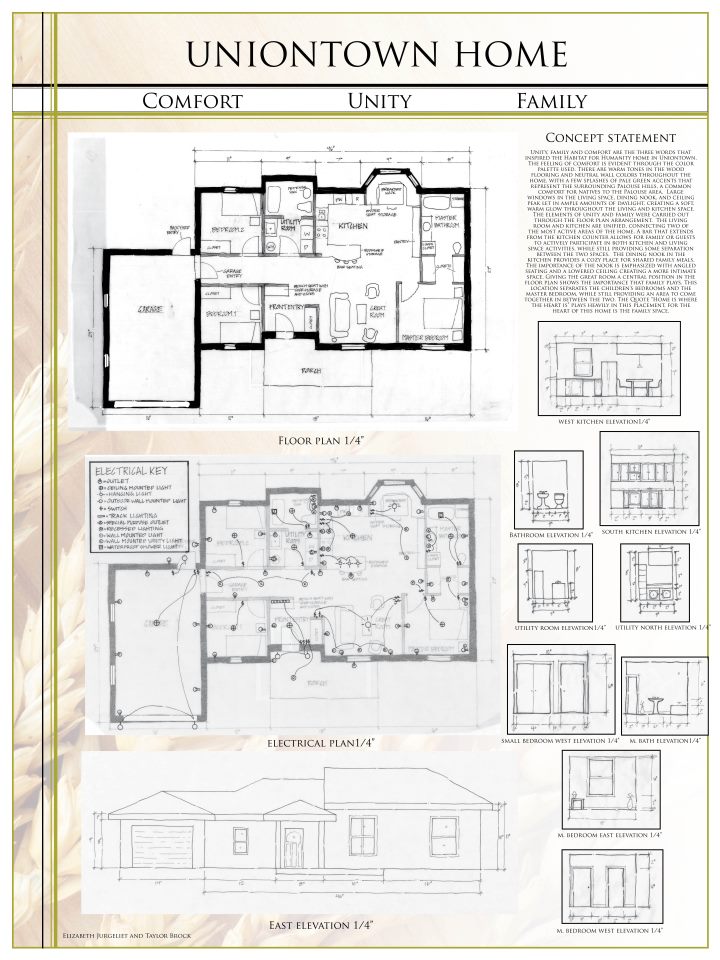
The first project of our Spring semester was one I took a personal liking to. We were given the opportunity to work with Habitat for Humanity here in the Palouse to design their next home. Although there wasn't a specific family chosen yet, we were given guidelines to help design the home. We were to design a 3 bedroom, 2 bath home in 1100 square feet. An open floor plan with a combined kitchen and living space was preferred. Budget was a large focus due to the need to keep the cost of the home low. We were also to keep mind sustainability and aging in place.

With all this in mind, my partner Liz and I worked to create a space any family could truly enjoy. We worked hard on finding a floor plan that was different from the floor plan of the previous year's Habitat House, to add to the specialness of the home the family would receive. To do this we placed the kitchen/living space in the center of the floor plan. The master bedroom is located on one side of this space, and the children's bedrooms and laundry room are on the other. This allows for a separation between the parent's and children's spaces while creating a combined living space in between. This floor plan arrangement is driven by the quote "Home is where the heart is." The heart of our home design is the family area.

Because there was not a family chosen by the time we did the project we decided to base our material choice on costs and sustainability. We chose to use a cork flooring, which we found for $2.98 a square foot, in the kitchen to help with sustainability. The entryway, utility room, and bathrooms use a marmoleum flooring that was around $3 a square foot. This material is more sustainable than vinyl, and is more durable than linoleum. The rest of the home uses a laminate wood flooring to help lower costs. The kitchen counter uses granite tiles which were $5.93 a square foot. The tiles still give the luxurious look of granite, while providing a much lower price. Although the price is higher than laminate counter top, the use of granite will increase the resale value of the home. The home is painted using a neutral color, but we chose to use an earthy green accent to pull in the comforting green tones of the Palouse.

We had to design the roof for the home and build it on our model, which helped show how much the floor plan can affect the roof. After way too many hours and a floor full of scraps I finally got our roof line to work, and I couldn't be more proud. Our wish to include vaulted ceilings with clerestory windows in the living space proved much harder than I expected but added the roof interest the Habitat committee was looking for.

Overall, this project was a great learning experience for me. Being able to communicate with actual clients provided an experience I never expected to have at this stage in my schooling. I was much more attentive to detail, and even more concerned about the decisions I made. Having worked on the previous habitat home allowed me to bring actual experience into the project.

Sunday, March 4, 2012

Context Poster

To get started on our next project for our Studio, the class was split into different groups and assigned a topic relating to either early 1900 design, or design for an art studio. My topic was prominent US architects of the 1930s, and I chose to research William Gray Purcell. I had no idea who he was, but his named kept popping up when I was searching. I learned a lot about Prairie Style design, a very common design type of the early 1900s. It was developed by Louis Sullivan, who taught Purcell, and was carried out by many architects including Frank Lloyd Wright, and Purcell himself. This style is reflected in the depot we are rehabilitating, so learning its origins and other ways it was applied was very helpful.

Tuesday, October 11, 2011

Day 2 of Seattle Adventures

Day two was really the day of adventures thanks to our directionally challenged group in our car. We started the day by getting lost on our way to Chown Hardwear in Bellevue. Once we found our way though we realized it was definitely worth it. The store was FULL of bathroom and kitchen fixtures and appliances, from faucets and sinks to toilets with bidets to drawer handles shaped like people. We were given a walk through of bathroom fixtures to help us with our upcoming bathroom project. I found some awesome ideas for it, as well as a few things I wanted for myself, like this tub.

We moved on next to Pental, a granite and marble showroom. This proved to be a lot more interesting than I expected because I'm currently taking a Geology class. I didn't think it would pertain to design all that much until I visited here. Everything she explained to us about their rock slabs were things I had learned in class! Actually seeing the huge slabs in person was really cool. They looked so much better than the small little samples we have in our materials room. I fell in love with a conglomerate granite called Jurassic Green.


Our next stop was 3 Form Lighting. I can't even begin to explain how much this show room inspired me. I found all of their work so intriguing. It was intricate yet simplistic. And the feel of the work space was so casual. I could tell it was an environment that encouraged imagination, especially thanks to the giant rainbow table they worked on. 3 Form is probably my favorite stop on the trip and I'm really interested in looking into a possible summer internship. 


The final stop of the day was the Daltile showroom. We got a brief overview of the company and were then let loose to roam the samples. Our bathroom project will be entered into a competition Daltile puts on so this was an important stop. We must use Daltile tiles in our bathroom, so we had to find what samples we were interested in using. I found some really neat river rock pebbles that were sliced to be flat that work perfectly with my concept.

Day two was long but very hands on so it was a fun day. I learned SO much about some of the main materials we use in designing. Being able to explore the show rooms and samples was a great way to give us experience with the materials.

Day 1 of Seattle Adventures

Our studio class was given the awesome opportunity take a field trip to Seattle for 4 days touring showrooms and even doing a job shadow.
The first day there we toured the Seattle Design Center. I had no idea what to expect because I had never heard of it. But once we got there I was in awe. Basically the design center is a giant mall for Interior Designers. There show rooms after show rooms with everything from custom furniture, rugs, to paint and fabric samples. I was overwhelmed with excitement and probably could have spent all day there.
We started at Trammell Gange. There you could find any customizable piece of furniture you could think of. Say you like the arms of one couch but the legs of another, and wanted to use a different fabric all together. No sweat! I was amazed.
We also toured a rug show room where some of the rugs were as much $28,000! And a wall coverings show room that had some really interesting materials like a velvety fabric for the wall.
The final show room we visited was Robert Allen. They were really welcoming with cookies, lemonade, and gift bags. They explained their fabric selection which was HUGE. I'm pretty sure you could find absolutely anything there. Sherwin Williams, the paint company, is a part of their show room as well so we also talked with their rep. She gave us our first paint wheels and gave us some important tips to remember when choosing paints.


Overall it was a long, but eye opening day. We learned so much about the materials and products available to just designers. My excitement throughout the day proved how much I love interior design. (And the garbage bags of samples a select few of us scored for hanging around after our class left may have helped too!)

Habitat For Humanity

A few weeks ago I was given the opportunity to work on a Habitat for Humanity house in Uniontown, a small town about half an hour south of Pullman. I've always heard of Habit for Humanity but never knew how or where to get involved, so I was quite excited when it was part of our curriculum for our Materials class.
Once we got to the site we were assigned different jobs and mine was insulation. I was really interested in it at first because we recently had our insulation redone on my house and I was curious about the process. But I quickly learned why the guys who did ours wore head to toe protection. Within 5-10 minutes my arms were itching like crazy, and they're starting to now just thinking about it. In addition to the itching it started getting stuck in my contacts. So my tip for you, DON'T WEAR CONTACTS IF YOU'RE WORKING ON INSULATION. Luckily I had contact solution with me so I got them all cleaned out and moved on to our next project.
Our next task was to clean out the rooms and screw down the floors. They were only held down with nails and lots of them were not along the cross beams. We went through and found the ones that weren't and added screws for extra strength. Easy right? Well, not as much for a group of girls with limited drill experience. We got our drilling lesson, but it took quite a few tries, and one bleeding finger, to really get the hang of it. But once we did we flew through it and finished early.
The experience was great because we got to work hands on with materials we had learned about in class. I am so glad I got the opportunity to work with Habitat for Humanity and I really hope and can work with them again in the future!

Wheelchair Adventure

One of the most interesting, and challenging, assignments we've had this year was our wheelchair assign. We were assigned a list of things to do, and we had to do all of them while in a wheelchair. At first I thought it would be a piece of cake, but it definitely wasn't. The first task already proved a challenge since I didn't know where the elevator was to get to the lower floor, and once I found it I had trouble turning myself around inside it.
Everyday tasks like opening doors and getting from one building to the next were much, much harder. If a door didn't have wheelchair accessibility, like the Architecture Library, I had to maneuver around it pulling the door while trying to simultaneously moving the wheelchair out of the way. Not an easy task.

 
And I learned how much I take my legs for advantage when we had to make our way from Daggy to Carpenter Hall. My usual path was way to steep to safely roll down so we went on a bit of an adventure to find an alternative route. The path we found was manageable at first, but about halfway there the sidewalk had be torn out and replaced with gravel! I had no choice but to use my legs to scoot myself along. If I hadn't have had use of my legs I would have been stuck.

This assignment proved a lot more worthwhile than I first expected. I learned how much harder everyday tasks become simply by being confined to a wheelchair. I have so much appreciation for people who must deal with this everyday now.

Wednesday, April 27, 2011

Sc Bench


For this project we made a poster showing the progress work of the bench we designed in our studio class. We took pictures and scanned sketches and models of different stages in the making of the bench.I showed my steps from my found object, a metal piece, to a concept model, to different benches. When working on the poster it was challenging picking which models and sketches were the most important in my steps since I had about 8 models and tons of sketches. After I picked the best ones however, it was really fun for me to recall why I made the bench that why, and how it led to what became my final bench. Making it into the poster really showed my progress work in a way I hadn't looked at before.

Monday, April 25, 2011

Thought Map Sketch


For this sketch we started with one word, mine being colorful, and we made a thought process map. We had to write down the first word that popped into our head from the previous word. "Rainbows" and "My Comforter" are my two beginning thoughts, and "Smoothies" and "Creativity" are where I ended. We also drew simple sketches to go along with the words. Once I finished it was really neat looking at where my thoughts ended up.

Napkin Sketch

For this sketch we drew on a napkin using a pen. We had to draw a perspective sketch of our room as well as a plan drawing of our room. I liked the idea of this sketch. Sometimes we'll be put in situations where we need to grab something real quick to jot down ideas, such as a napkin.

Figure Sketches


For this sketch we created figure drawing a few different ways. I've learned how to sketch figures using the method to the left, so that way was easier for me. It's easier for me to picture each piece of a person in order to make it proportional.

Figure Tracing Sketch


For this sketch we chose a picture of a figure and traced it. It was a bit difficult seeing through the paper but overall the sketch turned out well. I was helping tracing it using minimal lines because it helped me realize how little details you need to show a figure. This idea is helpful for drafting and showing human dimensions.

Fruit Cross Section Sketch


This is one of my favorite sketches. We had to take some fruits with interesting cross-sections and sketch them, using color if we wanted to. I felt I did a pretty good job sketching the shapes of the fruit and bringing out the cross-sections as well. I had a lot of fun adding color and I think it definitely enhanced my sketch.

Room Corner Sketch


For this sketch we had to find an interesting corner in a room and sketch it using shading techniques and perspective views as well. It was difficult sketching it at first because it has a two point perspective, but after I got a hang of it, it became much easier. I would have liked to spend more time on it so I could have straighter lines to make it look cleaner.

Black Paper Sketch


This sketch was really fun. The first time I turned it in I was asked to add more color and contrast to it because I only used white, yellow, and blue. The second time around I added purple, orange, and green. I showed contrast in lighting using contrasting colors. Overall, it was very interesting stepping out of my comfort zone of using exact colors, to create an interesting composition.

Eraser Sketch


For this sketch I shaded the whole page and used an eraser to create the image. I was sketching a potted plant. I used some shading in the dark negative space to show changes in lighting.It was difficult doing this sketch though, because we created it in a way opposite to what we are used to.